

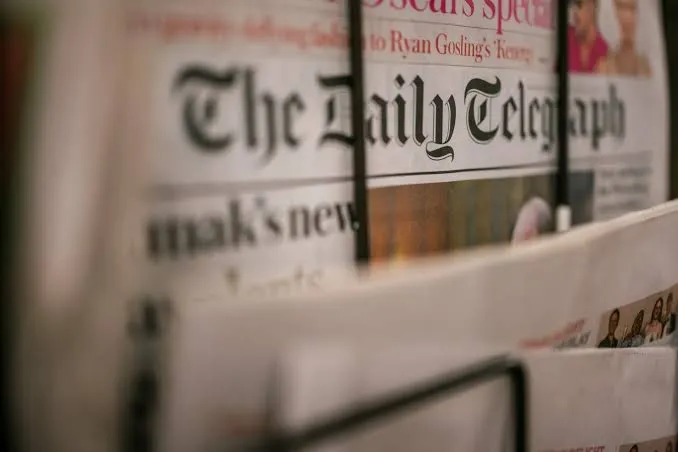
If the Telegraph is to be believed, Pakistan has suddenly become the puppet master of Europe. The Commonwealth bows, the European Union obeys, and somewhere in London, editors nod gravely as they print this fantasy. One wonders if Islamabad should be applauded for becoming the world's new superpower, or whether the Telegraph deserves pity for turning its newsroom into a marketplace for lobbyists. The story is not about Pakistan's influence but about the collapse of journalistic integrity in a paper that once claimed credibility.
The controversy began when the Telegraph published a piece alleging that a report critical of Pakistan was suppressed at the Commonwealth Parliamentary Association's meeting in London. The suggestion was that Pakistan leaned on international institutions and managed to silence voices against it. To the casual reader, this may sound like Pakistan has unmatched diplomatic muscles — bending the rules of the Commonwealth and even shaping discussions in Brussels. In reality, it exposes something far more ordinary and troubling: a British newspaper willingly printing a manufactured story, apparently financed by those who seek to malign Pakistan.
This is not an isolated incident. Across Europe, South Asia, and the Middle East, entire networks exist that specialize in planting stories against certain nations. Reports from credible organizations, including the EU DisinfoLab, have previously unmasked webs of fake NGOs and media outlets set up to attack Pakistan's reputation internationally. These networks operated for years before being caught. The Telegraph's recent adventure looks like another chapter of the same playbook, where money flows into the hands of lobbyists and newspapers become vehicles for propaganda.
What makes the Telegraph's narrative absurd is the sheer exaggeration of Pakistan's influence. This is a country still working tirelessly to stabilize its economy, fighting militancy on its soil, and addressing the challenges of climate change, poverty, and development. The idea that such a state can single-handedly manipulate the European Union and the Commonwealth with a phone call or two is laughable. More laughable is the belief that readers would not question how such extraordinary influence could be wielded without evidence. The only evidence that exists is the evidence of paid influence — not in Pakistan's corridors of power, but in the editorial desks of London.
The British media has long enjoyed the reputation of setting global narratives, but that prestige is built on the assumption of fairness and professionalism. When a newspaper of record allows itself to become a billboard for lobbyists, it chips away at whatever credibility remains. Readers do not expect a leading daily to act as a megaphone for those who cannot get their propaganda published elsewhere. The Telegraph's story does not injure Pakistan. It injures the very idea of free journalism that Britain claims to champion.
It also exposes a deeper hypocrisy. For decades, Western media has taken pride in highlighting censorship, lobbying, and media manipulation in the Global South. There are endless reports about how governments in developing countries pressure journalists or how money dictates coverage in weaker economies. But here, in the heart of London, a so-called respectable newspaper is accused of the very same crime — selling space to vested interests. When propaganda is dressed up as reporting, it no longer matters whether the target is Pakistan or any other state. What matters is that readers are deceived.
The motives behind this propaganda are not difficult to trace. Pakistan's growing diplomatic visibility, particularly in South Asia and the Muslim world, has not been welcomed by all. Its consistent stance on Kashmir, its call for justice in Palestine, and its active role in peacekeeping missions have all earned it friends among ordinary people but critics among powerful lobbies. For these groups, it is easier to spend money planting stories than to confront Pakistan's arguments on merit. Buying influence in London is cheaper than winning the debate in the United Nations.
The irony is that such smear campaigns often backfire. For the Telegraph to claim that Pakistan silenced voices at the Commonwealth is effectively to advertise Pakistan's strength. Instead of showing weakness, it paints the picture of a state so strong that it can make institutions in Europe dance to its tune. Readers with a critical eye can see the contradiction. Either Pakistan is struggling with domestic challenges, as is often portrayed, or it is all-powerful and pulling the strings of Europe. Both cannot be true. The inconsistency alone reveals that this is not serious reporting but a hired narrative.
In an age when disinformation has become one of the world's greatest threats, newspapers have a responsibility to resist becoming part of the problem. The EU has invested millions in combating fake news and countering malign influence operations. The irony that a respected British newspaper is now implicated in such influence operations should alarm European readers more than anyone else. If disinformation can be bought in London, then no institution is immune.
What the Telegraph has done is not just an attack on Pakistan's image; it is a betrayal of its own readers. People pay for news expecting facts, not fabricated tales written in the service of clients. When newspapers act as PR agencies, democracy suffers because citizens make judgments based on falsehoods. The damage done to public trust cannot be undone with an apology or a retraction. It lingers, feeding skepticism towards all media.
The episode also highlights a turning point for the British press. If financial pressures are driving newspapers to sell space to lobbies, then transparency becomes essential. Readers deserve to know which stories are journalism and which are sponsored narratives. Without such honesty, the boundary between fact and fiction disappears completely.
In the end, Pakistan emerges largely unscathed from this fiasco. Its position remains what it has always been: a country defending its sovereignty, raising its voice for justice internationally, and struggling with its internal challenges like many others. The real loser is the Telegraph, which now stands accused of selling its soul to those who could not win the argument in open forums. The scandal says nothing new about Pakistan but speaks volumes about the crisis of credibility haunting Western journalism.
When a newspaper once trusted for truth becomes a marketplace for propaganda, it is not Pakistan's image that is damaged but Britain's press freedom itself. Readers can tell the difference between journalism and lobbying. The Telegraph may have thought otherwise, but its miscalculation has only left its own reputation in tatters.
#Barinajans #Barınajans #HasanBarın #Gazze #Ankara #Devlet Bahçeli #GazaGenocide #Free Palestine #RecepTayyipErdoğan #Ali Erbaş #Rusya #Diyanet #Seninleyiz Reis
#SGEvGS #Sane #Yunus Akgün #Okan Frankfurt-Galatasaray #Milyoner #Eren #Konisyondan GenelAf #Beni Türk #Rusya'da 7.8 #Liverpool #Haram #Haydi Cimbom #$PEPPER